
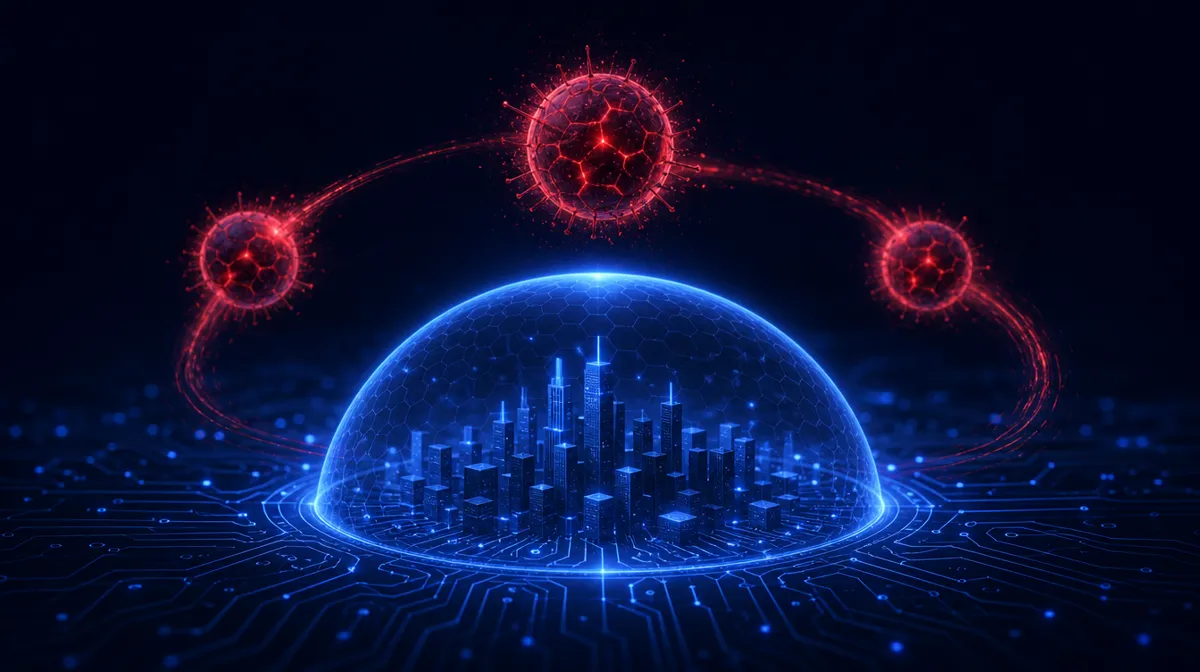
Based on current 2026 threat intelligence from multiple security research sources, here are the top three new or rapidly evolving malware/virus threats actively affecting corporate computers today. I’m focusing on threats that enter or persist on endpoints (what most business leaders still mean by “viruses”), not just abstract risk trends.
Top Three New Virus Threats Impact Corporate Computers in 2026
Cyber threats targeting corporate computers are evolving faster than traditional security strategies can keep pace. While the term “virus” is still commonly used, today’s most dangerous threats are more accurately described as adaptive malware ecosystems—often involving three main threats: ransomware, credential theft, and AI‑driven social engineering.
Understanding how these threats operate—and why traditional defenses frequently fail—is essential for business leaders responsible for protecting their organizations’ data, productivity, and reputation.
- AI‑Adaptive Ransomware: Most Disruptive Endpoint Threat
Ransomware remains the single most damaging form of malware affecting corporate computers, but its structure continues to evolve. Recent variants are human‑operated and AI‑assisted, allowing attackers to adapt their tactics in real time after initial access has been achieved (Sophos, 2026).
Unlike earlier ransomware strains that immediately encrypted files, modern attacks often delay encryption. Once a single corporate computer is compromised, attackers use stolen credentials to move laterally, evaluate backups, and export sensitive data before executing encryption or extortion. Security researchers note that many attacks now cause disruption even when encryption never occurs, using data theft and operational sabotage as leverage instead (TrustCloud, 2026).
Corporate endpoints are central to these attacks because employee workstations provide access to identity systems, cloud services, and internal networks. Once administrative or VPN credentials are captured from a compromised computer, attackers can escalate access privileges far beyond the original endpoint.
- Credential‑Stealing Infostealers: Silent Gateways
A second major threat affecting corporate computers is the rise of credential‑stealing infostealer malware. These programs are specifically designed to harvest saved browser passwords, cloud authentication tokens, and session cookies without triggering traditional antivirus alerts (Kaspersky, as summarized in DeepStrike, 2025).
Infostealers often arrive through phishing emails, fake invoices, or malicious document downloads that appear routine to end users. Because they rely on legitimate browsers and encrypted HTTPS traffic, their activity is difficult for endpoint protection tools to distinguish from normal behavior.
The risk to organizations is significant. Stolen credentials from a single laptop can enable attackers to access other users’ email accounts, cloud applications, and file storage systems without deploying additional malware. Industry reports consistently show that credential theft is now one of the most common initial access vectors in corporate breaches (Verizon, as cited in DeepStrike, 2025). In many cases, infostealers act as the prelude to more destructive ransomware attacks rather than causing immediate damage themselves.
- AI‑Generated Phishing Malware: Delivery Becomes the Weapon
While phishing is not a new problem, its effectiveness has increased dramatically due to generative AI. In 2026, researchers report a sharp rise in AI‑generated phishing campaigns that deliver malware or harvest credentials by convincingly impersonating internal communications (Cofense, 2025).
These attacks frequently combine email with follow‑up messages via collaboration platforms such as Microsoft Teams, SMS, or voice calls. Attachments may include malicious HTML, SVG, or cloud‑hosted documents that execute when opened on a corporate computer. Because the language, tone, and formatting so closely resemble legitimate internal messages, even security‑aware users are more likely to engage.
Phishing remains the dominant delivery method for malware affecting corporate endpoints. Data from phishing trend analyses show that AI‑assisted attacks are increasingly able to bypass email filtering and rely on social trust rather than technical exploits (Hoxhunt, 2026). As a result, the user’s device—rather than a server or firewall—continues to be the primary entry point.
Why These Threats Matter for Your Business
These three sophisticated threat types rely on corporate computers and user behavior. Endpoints now serve as identity vaults, cloud access gateways, and workflow hubs. Once compromised, they provide attackers with far greater reach than in past decades.
Antivirus software alone is no longer sufficient. Organizations need layered defenses—such as endpoint detection and response (EDR), multi‑factor authentication, and continuous user awareness—to avoid vulnerability. Today’s attacks succeed by combining malware with stolen credentials, legitimate tools, and social engineering.
Conclusion
The most significant virus threats affecting corporate computers in 2026 are not isolated pieces of malicious code but coordinated attack chains designed to exploit endpoints as gateways into the enterprise. AI‑adaptive ransomware, credential‑stealing infostealers, and AI‑generated phishing malware collectively account for a substantial share of modern security incidents. Businesses that understand these threats and respond with updated security controls are far better positioned to reduce disruption and financial risk.
References (IEEE Style)
[1] TrustCloud Community, “Top 10 emerging malware threats of 2026,” TrustCloud, Jan. 23, 2026. [Online]. Available: https://community.trustcloud.ai/article/top-10-emerging-malware-threats-of-2026/
[2] Sophos, “The state of ransomware in enterprise 2025,” Sophos Blog, Jan. 12, 2026. [Online]. Available: https://www.sophos.com/en-us/blog/the-state-of-ransomware-in-enterprise-2025
[3] M. Khalil, “Malware statistics 2026: Global enterprise threat data,” DeepStrike, Mar. 18, 2026. [Online]. Available: https://deepstrike.io/blog/Malware-Attacks-and-Infections-2025
[4] Cofense, “2026 phishing threat predictions: 5 key takeaways,” Cofense Blog, Dec. 4, 2025. [Online]. Available: https://cofense.com/blog/2026-phishing-threat-predictions-5-key-takeaways
[5] Hoxhunt, “Phishing trends report (updated for 2026),” Hoxhunt, 2026. [Online]. Available: https://hoxhunt.com/guide/phishing-trends-report
Quick Executive Summary
|
Threat Type |
Why It’s Dangerous |
|
AI‑Adaptive Ransomware |
Encrypts or destroys operations even with backups May not immediately encrypt; extracts data first |
|
Infostealers |
Stealthy, no alerts, gateway to full breach; uses legitimate browsers and HTTPS traffic |
|
AI Phishing Malware |
Bypasses human and technical controls; often hosted on legitimate cloud services; imitates internal communications |
Turn insight into action.
Take a free cybersecurity or AI readiness assessment, or book a call with a NetSys engineer — no obligation, no runaround.